Lucy walks around Tokyo along the Yamanote Line
The Earthquake BirdLucy Fly’s all-night walk around Tokyo along the Yamanote Line is both a physical circuit and a passage through the places that hold her memories of Teiji, Lily, and her earlier life in the city. Beginning after several days of near-immobility and ending at her starting point in Gotanda, the marathon-length journey gives the city a private geography: each station brings Lucy back to a different attachment, while the unbroken forward motion offers temporary distance from the thoughts that wound her.
The Walk Begins
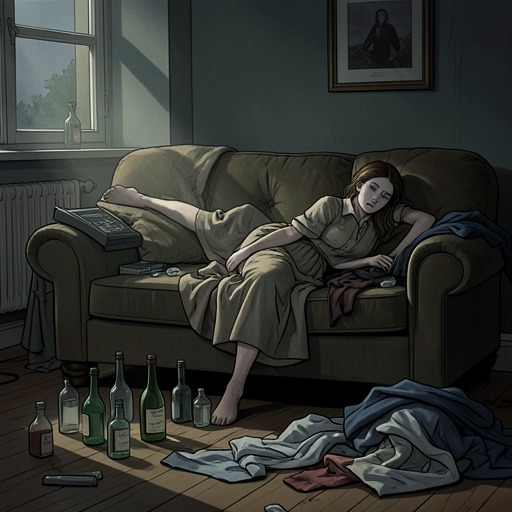
For three days after losing both her lover and her friend, Lucy remains mostly on the floor of her apartment, listening to the garage and uncertain whether she sleeps. She does not intend to speak to Lily or Teiji again. On the fourth day, Lily’s repeated calls continue through the morning. Lucy does not unplug the phone: she wants to know that Lily is trying to reach her, even as she refuses to answer. By evening, the phone’s persistent sound has become impossible to bear, and Lucy leaves without choosing a destination or route.
From Gotanda, she heads counterclockwise toward Osaki. The road is quieter and darker than the parts of Tokyo illuminated by neon, and the air against her stiff body feels welcome. But stopping in Osaki brings back the handkerchief and ice cream that passed between Lily and Teiji, and their abandonment of Lucy on the cliffs. She resumes walking because movement makes her thoughts move faster and less clearly, weakening their ability to inflict fresh pain. She follows the railway to one station and then the next, turning an aimless departure into a sustained circuit.
Tokyo as a Personal Map
The stations do not form a blank route for Lucy. Each arrival feels like a kind of homecoming because she knows the neighborhoods as distinct zones of her life. She thinks of the Yamanote Line as a ring of twenty-eight stations, twenty-eight individual beads, each with its own character. The journey therefore measures more than distance: it brings the city’s scattered memories into sequence without making them resolve into a single, comforting story.
At Shinbashi, Lucy passes the old steam engine where she once waited for Natsuko before they took another train to Odaiba. She recalls their rotation in a small capsule on the large Ferris wheel, looking out at Rainbow Bridge, Tokyo Tower, industrial plants, and the gray sea. At Yurakucho, she runs her fingers along the sooty bricks beneath the railway arches. Restaurants sit under those curves; in one, she sometimes met Bob, who asked her advice about his life. Over spicy Chinese food, he told her he hoped to become a rock star, though at forty-one he thought the opportunity was late, and explained that cosmetic dental work had been part of that ambition.
Tokyo Station passes quickly, its converging lines difficult for Lucy to distinguish. When they separate, she follows her intuition and finds the Yamanote Line again at Kanda. By the ninth or tenth station, retracing her route seems pointless, so she continues. At Akihabara, she remembers looking at cameras with Teiji, who never bought one. Ameyoko recalls shopping there with Natsuko for inexpensive food; the now-quiet market seems to retain the daytime calls of vendors selling squid, fish, tea, coffee, and shoes. In Ueno, she remembers the crowded cherry-blossom viewing of her first year. At Yanaka, the cemetery rises beyond the tracks, its tombstones appearing in the dark like seated figures. She passes the old shrine at Komagome and continues through Ikebukuro toward Teiji’s territory.
Returning to Earlier Attachments
The city’s foreground changes from markets and parks to nightclubs, love hotels, tombstones, shops, and embassies, but the larger landscape remains a corridor of rectangular buildings and railway tracks. Lucy looks into illuminated windows, trying to catch glimpses of people moving inside. She wonders who they are among the millions who work, wake, and sleep in the city’s stacked homes and workplaces. Her curiosity carries a recognition with it: she wants to know these strangers because she, too, is one of them, moving between private boxes in a vast urban system.
When she loses sight of the tracks, Lucy makes her way through shadowed side streets, using bright vending machines as markers before finding the railway again. In the early hours, she reaches Shinjuku, only metres from the place where she first saw Teiji. That earlier encounter had begun during one of Lucy’s solitary walks through Tokyo; before meeting him, she had not described herself as lonely, yet she could not bear to leave him and be alone again. Now the same district directs her attention to Sachi. The small theater where Teiji found Sachi might be only a street or block away. Lucy wonders how much time separated Sachi’s departure from her own arrival, and whether Teiji moved from Sachi to Lucy and then to Lily without pause, as if the three women were consecutive stations on a line. The thought is her conjecture, not an established account of Teiji’s relationships, but the walk makes it newly imaginable by placing the women within one continuous urban route.
The Circuit Closes
Lucy walks past Yoyogi Park. She cannot see inside its walls, but the treetops rise above them, and she hears again the song she sang there with Teiji and Lily, Ue o Muite Arukou. She cries without lifting her head to stop the tears, because the road is empty and there is no one there to see her. The song brings the three of them into the same remembered moment even as the present walk registers their separation.
She reaches her office in Shibuya, a place she has never seen at night and is glad to encounter. It seems perhaps the only place in Tokyo where she can feel at home without Teiji or Lily. Lucy considers returning to work soon and thinks of the blast-furnace translation, hoping it has been completed on time and to a satisfactory standard. As sunrise brings people out for work and school, she walks from Ebisu to Meguro and finally back to Gotanda. She has covered the distance of a marathon and circled Tokyo. The telephone is still ringing when she enters her flat; rather than answer, she fills a bathtub and sinks into the hot, soapy water, her feet throbbing after the walk.
Narrative Significance
The circuit converts wandering into a form of recollection. Lucy’s route is not planned as a tour, but the railway repeatedly brings her past places attached to friends, work, desire, and loss. Familiarity provides neither escape from memory nor a return to uncomplicated belonging: each station offers a brief homecoming, while the full loop brings her back to the apartment and the unanswered phone from which she left.
The walk also gives physical form to Lucy’s effort to keep painful thoughts in motion. She does not settle what happened between Teiji, Sachi, Lily, and herself; instead, the sequence of neighborhoods allows her to approach those uncertainties from different points in the city. Completing the loop is a clear change in circumstance—she leaves her apartment unable to endure the ringing phone and returns after a night on foot—but it does not restore the relationships she has lost. Tokyo holds the memories together even as Lucy remains apart from the people at their center.